


For years, IT teams have faced the same painful trade-off: higher IOPS means paying for premium disk tiers and over-provisioning compute just to hit throughput targets.
Native cloud storage ties performance directly to capacity — want more speed, buy more disk.
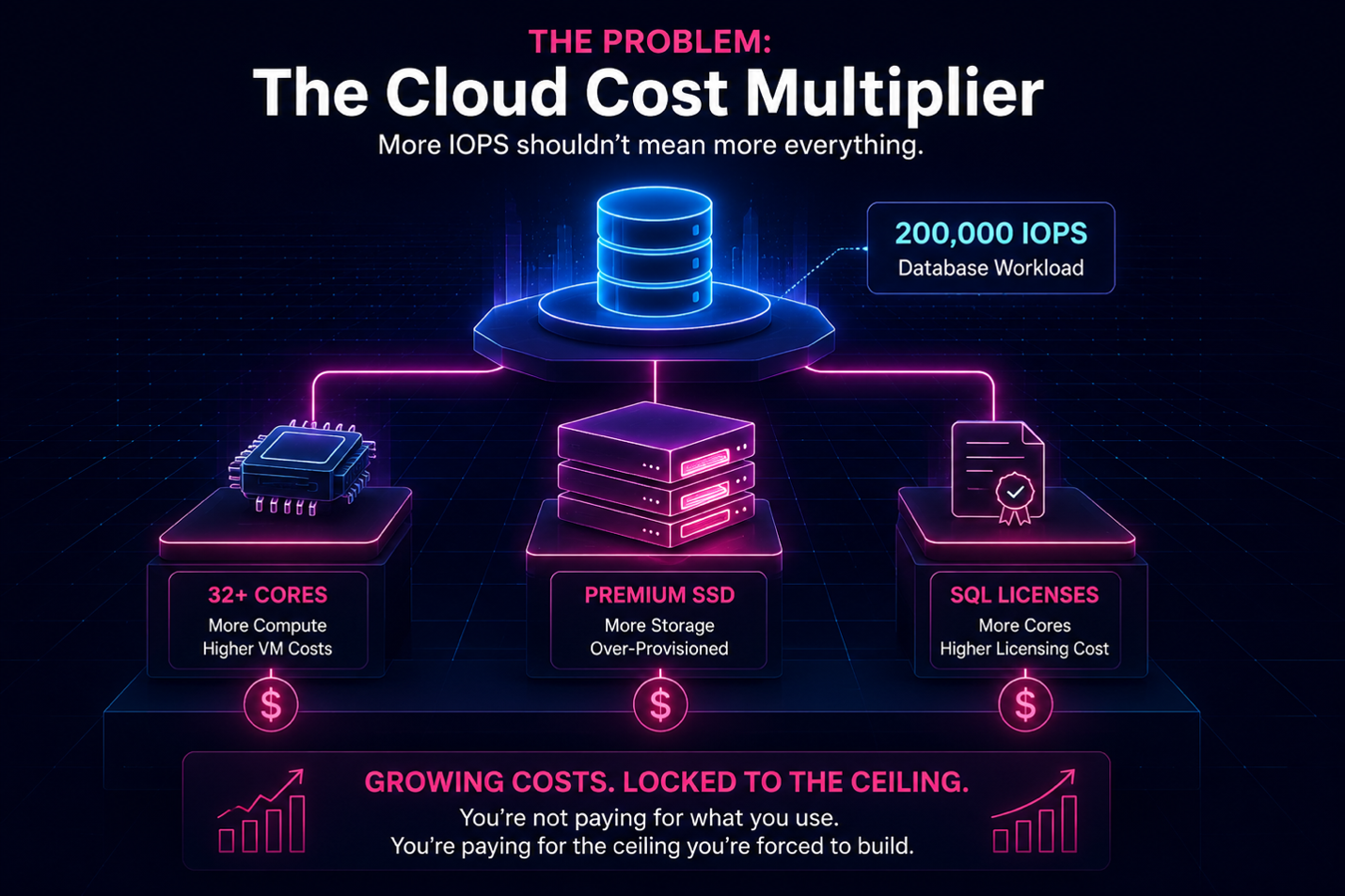
For I/O-intensive applications migrated from on prem to the cloud, this creates a compounding problem most teams underestimate. Increasing core counts to reach the IOPS your database needs doesn’t just raise VM costs — it multiplies database licensing fees (SQL Server, Oracle) in lockstep. And running Prod alongside Dev/Test means duplicating everything on those expensive premium tiers. After all, these applications can run in the cloud but they were not built for the cloud.
Consider a workload requiring 200,000 IOPS on Azure. Native Premium SSD forces you to 32+ cores to hit that number — which can triple your SQL Server licensing cost compared to a properly decoupled architecture. You’re not paying for what you use; you’re paying for the ceiling you’re forced to build.
But what if that trade-off no longer exists?
A Software-Defined SAN, Delivered in the Cloud
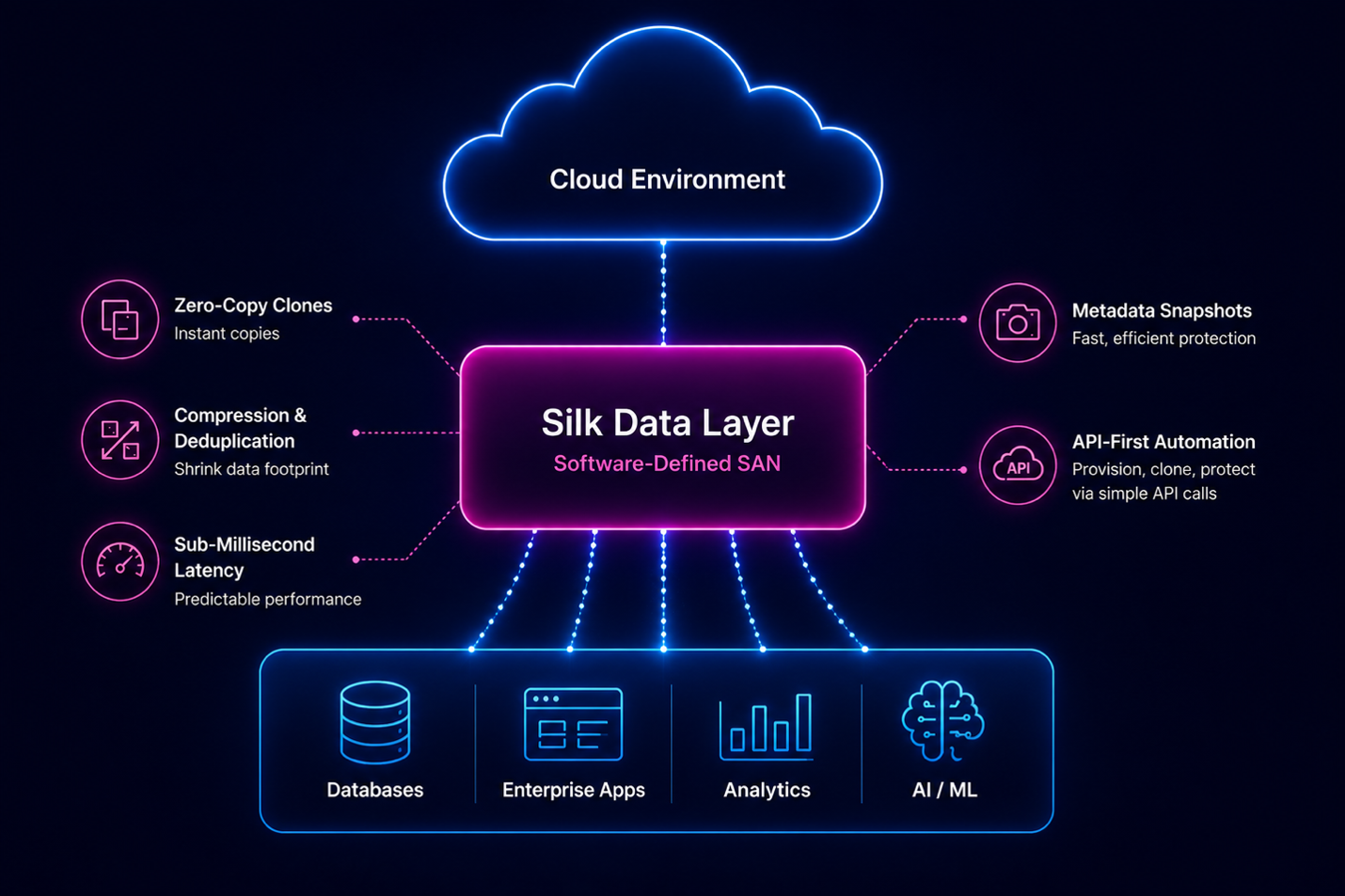
Silk brings data centre-grade SAN architecture into cloud environments — decoupling performance from capacity so you no longer must buy storage headroom just to get the IOPS you need.
With Silk in your cloud environment:
- Performance scales independently from capacity — no over-provisioning
- Storage is centralised and optimised across workloads
- Zero-copy clones spin up in minutes via simple API calls
- Data footprints shrink by over 50% through compression and deduplication
- Metadata snapshots replace slow, expensive full backups
- Latency stays sub-millisecond, predictably, under load
In short: Silk eliminates the cloud performance-vs-cost trade-off and makes the cloud behave like a high-performance enterprise data centre.
The Numbers That Matter
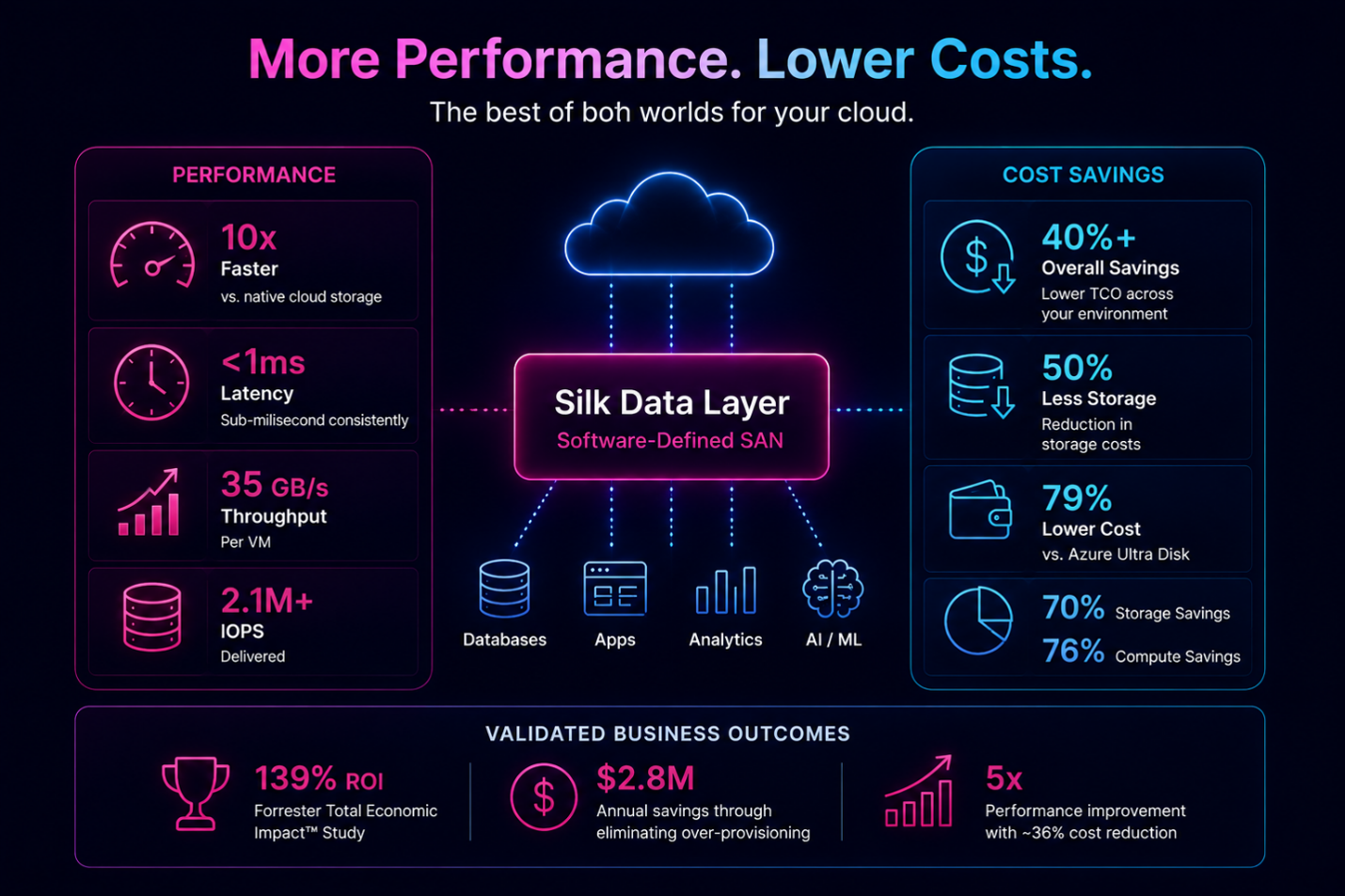
Performance
- Up to 10x faster than native cloud storage
- Sub-millisecond latency for consistent workloads
- Up to 35 GB/s throughput per VM
- Over 2.1 million IOPS delivered
Cost
- 40%+ overall cloud cost savings
- Up to 50% reduction in storage costs
- 79% lower cost vs Azure Ultra Disk
- Up to 70% storage savings and 76% compute savings
Validated Business Outcomes
- 139% ROI — Forrester Total Economic Impact study
- $2.8M annual savings through eliminating over-provisioning
- 5x performance improvement with ~36% cost reduction
Are You Overpaying Right Now?
The exact savings depend on your workload mix, storage volumes, and licensing profile — but here’s a practical rule of thumb: from around 40TB of fast disk and 128 cores of database licensing, there’s almost always a compelling cost case on Azure spend alone, before you factor in operational efficiency.
If you’re running SQL Server, Oracle, or PostgreSQL at scale — or operating AI/analytics pipelines, high-frequency transactional workloads, or environments where Dev/Test clones consume significant storage — you could be overpaying by 30–70% right now.
The ability to create instant database copies, clones, and mount them on different VMs isn’t just a storage feature — it increases the speed and quality of data for Dev/Test teams and their ability to innovate.
See Your Numbers
Run the numbers yourself with the free Azure Cost Savings Calculator:
silk.us/azure-cost-savings-calculator
Or book a no-cost Cloud Cost and Performance Assessment. We’ll map your current cloud bill against:
- Where you could reduce your resource footprint
- What performance gains are achievable for your workloads
- What your real savings could look like
No disruption, no refactoring — just a clear picture of what’s possible with your current environment.

Jon Moore
Senior Technical Account Manager
Experienced cross-discipline IT solutions and delivery consultant, specialising in Hybrid Cloud Infrastructure solutions (Nutanix, Rubrik, HYCU, Citrix, AWS, Azure, Acronis, Scale). Ex-IT Manager/Infrastructure Manager/Cloud Architect who has deployed most of what he gets excited about. Loves the water (I’m a swimming teacher, powerboat and sailing instructor)…who loves to drown in technology!
Show all articles by Jon MooreRelated reading from the works
NHS North East London lowers costs and improves efficiency with a switch to Nutanix
Keepit

Mimecast Cyber Resilience Solutions